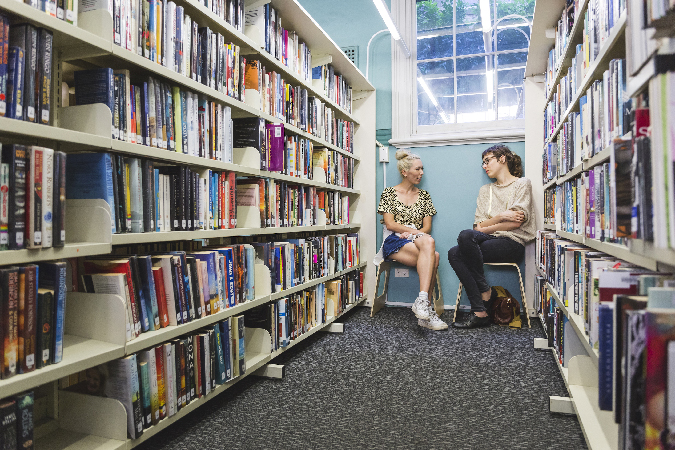
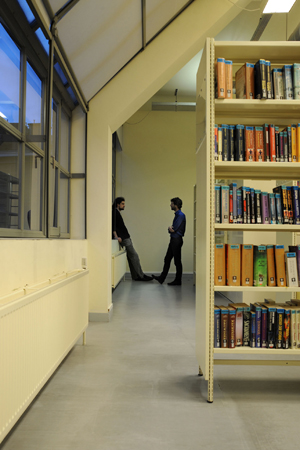
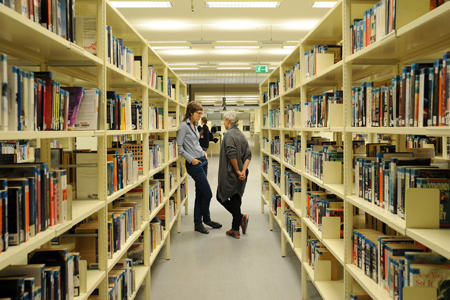
For ‘Time has fallen asleep in the afternoon sunshine’ a group of people/ performers memorize a book of their choice. Together they form a library collection consisting of living books. The books are passing their time in a library, sitting in chairs, walking around, talking together, looking out of the window, reading in paper-books from the shelves, ready to be consulted by a visitor. The visitors of the library choose a book they would like to read, and the book brings its reader to a place or setting in the library, in the cafeteria, or for a walk outside, while reciting its content (and possibly valid interpretations).
The idea for this library of living books comes from the science fiction novel Fahrenheit 451. It is a future vision of a society where books are forbidden because they are considered dangerous, that happiness must be obtained through an absence of knowledge and individual thought. The number 451 refers to the temperature at which book paper starts to burn. As books are forbidden in this society an underground community of people learn books by heart in order to preserve them for the future.
Books are read to remember and written to forget. To memorize a book, or more poetically ‘to learn a book by heart’, is in a way a rewriting of that book. In the process of memorizing, the reader for a moment steps into the place of the writer, or rather he/ she is becoming the book. Maybe the ability to learn a whole book by heart is relative to what book you choose, the time you invest, and perhaps your skills. But, however much or well you learn something by heart you have to keep practicing it otherwise you will forget it again. Perhaps by the time you reach the end you will have forgotten the beginning. Learning a book by heart is an ongoing activity and doing. There is nothing final or material to achieve, the practice of learning a book by heart is a continuous process of remembering and forgetting.
concept: Mette Edvardsen
with: Aaron Virdee, Adriana Gheorghe, Adriano Wilfert Jensen, Agate Bankava, Alexandra Napier, Alice Monica Marinescu, Alice Rensy, Amalie Bergstein, Andrea Maurer, Andrea Rodrigo, Angela Goh, Boing Yuen Hau-Ching, Boyong Kim, Bruno De Wachter, Brynjar Bandlien, Camilla Høg, Caroline Daish, Chloe Fisher, Choi Beumkyu, Connie.Y, David Helbich, Dmitrijs Gaitjukevics, Dolores Hulan, Ellie Law Ching Sum, Elly Clarke, Emmilou Rößling, Esperanza Gomez Carrera, Ewa Chmielewska, Freja Bäckman, Frøydis Århus, Giota Bibli, Hayeon Kim, Helena Polasik, Ida Katinka Fridan Pedersen, Ilinca Hărnuț, Irena Radmanovic, Irini Tsava, Isadora Angelini, Iulia Maracine, Izar Okariz, Jaanika Tammaru, Jan Kühling, Joana Ferraz, Johan Sonnenschein, Jon Refsdal Moe, Jude Joseph, Julie Pfleiderer, Justine Maxelon, Kaarel Targo, Kamil Malecki, Kaija M. Kalvet, Katarzyna Mazurkiewicz, Katarzyna Stankiewicz, Kathy Kyunghoo Lee, Katja Dreyer, Kil KyungHa, Kim Boyong, Kim Hayeon, Kong Ho Yin, Kristien Van den Brande, Kristine Øren, Kristo Veinberg, Kyungha Kil, Laura Niils, Léa Poiré, Lea Vendelbo Petersen, Lee Kyunghoo, Lihua Yu, Lilia Mestre, Lizzie Thompson, Luigi Pignati, Mara Brašmane, Mari Matre Larsen, Marit Ødegaard, Maria Psarologou, Marios Kritikopoulos, Martin Slaatto, Mette Edvardsen, Michelangelo Miccolis, Mihkel Kallaste, Mikko Hyvönen, Moqapi Selassie, Muna Mussie, Nicholas Von Kleist, Paloma Mecozzi, Pâmela Sarabia, Patricia Woods, Peteris Krilovs, Philip Holyman, Pivinnguaq Mørch, Pyun Jiji, Rasa Jansone, Rauno Polman, Razan Akramawy, Reinis Ivanovs, Rhiannon Newton, Rosemary Lee, Roza Moshtaghi, Sarah Ludi, Sara Masotti, Satu Herrala, Sébastien Hendrickx, Simon Asencio, Siriol Joyner, Sonia Si Ahmed, Staffan Eek, Stephanie Amin, Thomas Bîrzan, Tiziana Penna, Tom Engels, Trista Ma Ka Yue, Ulf Nilseng, Usama Zurba, Valdis Abols, Veridiana Zurita, Vincent Dunoyer, Violeta Gil, Wouter Krokaert, Wu King Yeung, Yun Eunkeong, …
production assistant: Hedvig Bergem Søiland
graphic design print: Michaël Bussaer
production: Mette Edvardsen/ Athome
co-production: Dubbelspel - STUK Kunstencentrum & 30CC (Leuven), Dance Umbrella (London), Kunstenfestivaldesarts (Brussels), NEXT Arts Festival (Valenciennes, Lille, Kortrijk, Villeneuve d'Ascq), Wiener Festwochen (Vienna), Oslobiennalen First Edition 2019 - 2021 (Oslo), Museo Reina Sofia (Madrid), Dansehallerne (Copenhagen), 34th São Paulo Biennale (São Paulo), centre chorégraphique national de Caen in Normandie (Caen), Les Laboratoires d’Aubervilliers (Paris)
supported by: Norsk Kulturråd
additional support by: Fond for Lyd og Bilde, Fond for Utøvende Kunstnere, Norwegian Ministry of Foreign Affairs, Flemish Authorities
special thanks to: Bibliothèque royale de Belgique/Koninklijke Bibliotheek van België, Sarah Vanhee, Els De Bodt
thanks to: Maya Wilsens, Frøydis Århus, Cillian O'Neill, Andrea Skotland for production assistance
title: “Time has fallen asleep in the afternoon sunshine” is a sentence from a book by Alexander Smith appearing in Fahrenheit 451 by Ray Bradbury (1953).
PRESENTATIONS:
(O)utpost Flørli, rimiimir scenekunst (Flørli) 6, 7, 8 June 2025
Indómitas - POETAS & Feria del Libro de Madrid (Madrid) 2, 3 June 2025
Analog Festival (Bad Goisern) 12, 13, 14 September 2024
Les Laboratoires d’Aubervilliers (Aubervilliers) 9 June 2024
(O)utpost Flørli, rimiimir scenekunst (Flørli) 30 May, 1, 2 June 2024
French May, Taste Library (Hong Kong) 11, 18, 25 May, 1, 2, 8 June 2024
Ob/scene Festival (Seoul) 17 - 26 November 2023
Exploring Pluralities & Cărturești Carusel (Bucharest) 16, 17, 18 November 2023
La Semaine Bleue, Bibliothèque Robert Desnos (Montreuil) 7 October 2023
Festival Partir en livre & Bibliothèque Elsa Triolet (Pantin) 28 June, 8 July 2023
(O)UTPOST FLØRLI, rimi/imir scenekunst (Flørli) 1, 2, 3, 4 June 2023
Festival Hors Limites & Les Laboratoires d’Aubervilliers (Noisy-le-Sec, Paris) 15 April 2023
Les Laboratoires d’Aubervilliers & residences (Paris) 10, 14 December 2022
Moving in November (Helsinki) 6, 7, 8 & 10, 11, 12 November 2022
Si loin si proche, Les Subs (Lyon) 12, 13 14, 15 October 2022
Movement Festival 2022 – A Void, Eaton HK (Hong Kong) 24, 25 September 2022
Museo Reina Sofia (Madrid) 19, 20, 21 September 2022
Festival EXTRA! Centre Pompidou (Paris) 10, 11 September 2022
Exploring Pluralities (Bucharest) 5, 6, 7 July 2022
(O)UTPOST FLØRLI, imir/rimi scenekunst (Flørli) 3, 4, 5 June 2022
Oslo Internasjonale Teaterfestival, Black Box teater (Oslo) 16, 17 March 2022
Deichman Bjørvika (Oslo) 20 November 2021
Museo Reina Sofia (Madrid) 27, 28, 29 October 2021
Baredans v Det Vilde Ord (Bodø) 14, 15, 16 October 2021
34th São Paulo Biennale (São Paulo) 3 September - 5 December 2021
Dansehallerne & Sundby Bibliotek (Copenhagen) 23 - 27 August 2021
Festival EPOQUE & centre chorégraphique national de Caen en Normandie (Caen) 30 May, 1, 2 June 2021
Norsk Litteraturfestival (Lillehammer) 29, 30 May 2021
Trust & Confusion, Tai Kwun Arts (Hong Kong) 1 May - 29 August 2021
Museo Reina Sofia (Madrid) 12, 13 November 2020
Ob.Scene 2020 (Seoul) 10, 11, 17, 18, 24, 25 October 2020
Homo Novus & National Library (Riga) 5, 6, 7, 8, 9, 10 September 2020
Little Fun Palace Nomadic School (Viote, Mount Bondone) 29, 30 August 2020
osloBIENNALEN, Black Box teater & Deichman Tøyen (Oslo) 17, 18, 19, 20 October 2019
Sur les bords#1/ T2G-CDN (Gennevilliers) 5, 6 October 2019
Today is our Tomorrow, PUBLICS (Helsinki) 12, 13, 14 September 2019
osloBIENNALEN, Black Box teater & Deichman Grünerløkka (Oslo) 12, 14, 15 September 2019
Festival de Genève, La Bâtie & Fondation Bodmer (Cologny) 14 September 2019
Festival de Genève, La Bâtie & Bibliothèque de Nyon (Nyon) 12 September 2019
Festival de Genève, La Bâtie & Château de Ferney Voltaire (Ferney-Voltaire) 11 September 2019
Festival de Genève, La Bâtie & Bibliothèque municipale de la Cité (Geneva) 10, 13 September 2019
Festival de Genève, La Bâtie & Bibliothèque le Balcon de St-Cergues (St-Cergues) 9 September 2019
osloBIENNALEN & Ekebergparken (Oslo) 11, 12, 13, 14, 18, 19, 20, 21 July 2019
Dansand (Ostende) 6, 7 July 2019
osloBIENNALEN & Ekebergparken (Oslo) 25, 26 May 2019
osloBIENNALEN (Oslo) 25 May - 27 October 2019
Wiener Festwochen (Vienna) 11, 12, 13, 14, 15, 16, 17, 18 May 2019
IMMATERIAL Vol. 3, Material Art Fair (Mexico City) 7, 8, 9 February 2019
Index Foundation (Stockholm) 25 January - 17 March 2019
NEXT Arts Festival, La rose des vents, Bibliothèque Universitaire SHS – Sciences Humaines et Sociales (Villeneuve d’Ascq) 27, 28, 29, 30 Novembre 2018
NEXT Arts Festival, Schouwburg Kortrijk, Art Centre BUDA, Bibliotheek Kortrijk (Kortrijk) 21, 22, 23, 24 November 2018
NEXT Arts Festival, Théâtre du Nord, Médiathèque La Grand Plage (Roubaix) 15 November 2018
NEXT Arts Festival, Théâtre du Nord, Médiathèque de Lille Sud (Lille) 16 November 2018
NEXT Arts Festival, Théâtre du Nord, Médiathèque André Malraux (Tourcoing) 17 November 2018
NEXT Arts Festival, le phénix scène national pôle européen de création, Médiathèque Le Quai (Condé-sur-L'escaut) 13 November 2018
NEXT Arts Festival, le phénix scène national pôle européen de création, Bibliothèque Victor Hugo (Onnaing) 9 November 2018
NEXT Arts Festival, le phénix scène national pôle européen de création, Bibliothèque universitaire du Mont-Houy - Université de Valenciennes et du Hainaut-Cambrésis (Aulnoy-lez-Valenciennes) 10, 12, 14 November 2018
Nordnorsk Kunstsenter& Rana Bibliotek (Mo i Rana) 1, 2, 3 February 2018
De Nacht van Permeke, Bibliotheek Permeke (Antwerp) 6 January 2018
Jugendstilsenteret, Kunstmuseet KUBE & Ålesund bibliotek (Ålesund) 2, 3 December 2017
Nuuk Nordic & The Public and National Library of Greenland (Nuuk) 17, 18, 19, 20 October 2017
Imir Scenekunst, Kapittel & Stavanger bibliotek (Stavanger) 20, 21, 22, 23 September 2017
Kortreist Dansefestival & Inderøy bibliotek (Inderøy) 27, 28 June 2017
Kunstenfestivaldesarts, Ravenstein Gallery (Brussels) 6 - 27 May 2017
Live Arts Week – Gianni Peng VI by Xing (Bologna) 26 April 2017
What is Happening to Our Brain, Stedelijk Museum (Amsterdam) 24 March 2017
The Giver, The Guest & The Ghost, OSLO PILOT, Posthallen (Oslo) 17, 18 November 2016
Weld & Stockholms Statsbibliotek (Stockholm) 29, 30 October 2016
Kristiansand Kunsthall & Kristiansand Folkebibliotek (Kristiansand) 21, 22, 23 October 2016
Indiscipline, Palais de Tokyo (Paris) 3, 4 September 2016
Sydney Biennale & Newtown Library (Sydney) 14, 15, 16, 17, 18, 19 March 2016
Mind the Book, Vooruit & Openbare Bibliotheek (Gent) 9, 10, 11, 12 March 2016
Le Quartz & Bibliotèque Unviversitaire de Lettres de Brest (Brest) 3, 4, 5 March 2016
Keine Disziplin, Gessnerallee &PBZ Bibliothek Altstadt (Zurich) 2, 3, 4, 5, 6 February 2016
Santarcangelo festival & Biblioteca comunale A. Baldini (Santarcangelo) 9-12, 14-19 July 2015
Translate, intertwine, transgress! Moderna Museet & MDT (Stockholm) 11, 12, 13 June 2015
MaerzMusik, Berliner Festspiele (Berlin) 21, 22 March 2015
Ordkalotten litteraturfestival & Tromsø Bibliotek (Tromsø) 1, 2, 3, 4 October 2014
Festival Baltoscandal & Lääne-Viru County Central Library (Rakvere) 3, 4, 5 July 2014
Bonds of Culture festival, Kana Teatr & Public Library Szczecin (Szczecin) 3, 4, 5 July 2014
Sommerszene, Szene Salzburg & Stadtbibliothek (Salzburg) 26, 27, 28 June 2014
Live Arts Week – Gianni Peng III by Xing & Biblioteca Salaborsa (Bologna) 8, 9, 10, 11, 12 April 2014
Bonds of Culture festival, Kana Teatr & Public Library Szczecin (Szczecin) 5, 6 July 2013
Kunstenfestivaldesarts & Bibliothèque royale de Belgique/Koninklijke Bibliotheek van België (Brussels) 4, 7, 8, 16, 17, 18, 23, 24, 25 May 2013
Æ Å Litteraturfestival, Teaterhuset Avant Garden & Trondheim Folkebibliotek (Trondheim) 2, 3, 4 May 2013
A Thing At A Time, Witte de With (Rotterdam) 20 April 2013
MIR festival & National Library (Athens) 10, 11, 12, 13 December 2012
Dansefestival Barents & Hammerfest Bibliotek (Hammerfest) 8, 9, 10 November 2012
Oktoberdans, BIT & Bergen Offentlige Bibliotek (Bergen) 22, 23, 24, 25, 26, 27 October 2012
Dance Umbrella & Islington Central Library (London) 10, 11, 12, 13 October 2012
In-Presentable, La Casa Encendida (Madrid) 10 - 24 June 2012
Fierce Festival & Central Library (Birmingham) 30, 31 March + 2, 3, 4, 5, 7 April 2012
Marstrand vol. IV, Black Box Teater & Deichmanske Bibliotek Grünerløkka (Oslo) 23, 24, 25 March 2012
Something Raw, Frascati & Pintohuis Bibliotheek (Amsterdam) 15, 17, 18 February 2012
Jerusalem Show, Al-Ma'Mal Foundation & The Educational Bookshop (Jerusalem) 28, 29, 31 October + 1, 2 November 2011
Playground, STUK & Bibliotheek Tweebronnen (Leuven) 4, 5, 6, 8, 9, 10 November 2010